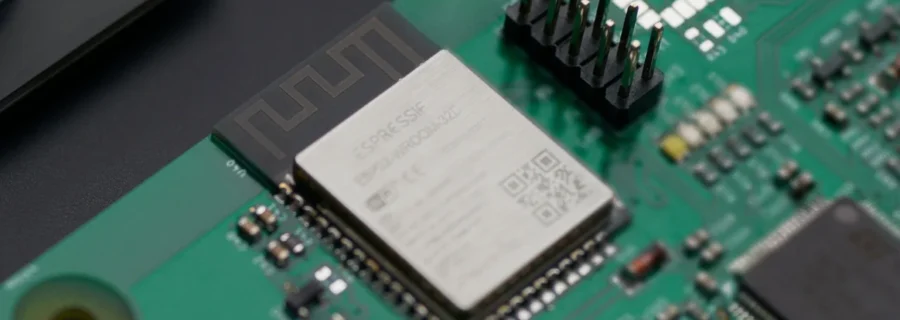
Nowadays, most IoT devices are based on wireless communication. But how does a device know that another device is trying to tell it something? The answer lies in two small parts of almost every radio packet: the preamble and sync word. RF communication is actually similar to the way humans communicate, using their ears and mouths.
The radio ether is a noisy environment. You can compare it to a shopping mall or a school hallway with a lot of people talking. How is it possible that you can still talk with your friend when your ears constantly hear that noise? Our brain is looking for familiar patterns, such as familiar voices or someone calling our name, to catch our attention. Radio receivers work in a very similar way.
The beginning of wireless transmissions
Long before embedded chips were using Bluetooth, LoRa, or Wi-Fi out of the box, engineers faced the exact same fundamental problem: how to make sure a message gets heard through a noisy medium? It started with basic signals, limited by human senses and line of sight, like lighting a fire on a distant hill.
Radio Frequency breakthrough
A major leap in structured communication was the invention of Morse’s telegraph, which was initially wired. But in the 20th century, through the work of James Clerk Maxwell, Heinrich Hertz, and Guglielmo Marconi, the Morse code was transmitted wirelessly. They used a high-voltage spark to generate a blast of wideband Radio Frequency (RF) noise, and the Morse code was transmitted across the Atlantic Ocean.
For the next decades, radio was dominated by analog continuous waves, broadcasting voice and music. But analog is not good for sending precise, error-free data, and the receiver device must listen to the radio all the time.
The first structured RF protocols
As the airwaves became a crowded room with thousands of devices transmitting simultaneously, simply blasting a signal wasn’t enough. Devices needed strict rules of engagement to wake up, identify themselves, sync their internal clocks, and ignore background noise. This led to modern RF framing structures, preambles, sync words, and addressing that every embedded engineer working with IoT today still relies on, often without realizing it. One of the pioneers of digital structured RF protocols is POCSAG (Post Office Code Standardisation Advisory Group).
The physical layer of RF modulation
Before a transmitter and receiver can worry about the protocol they use (like the language we use), they must agree on how a binary 1 and 0 actually look as physical electromagnetic waves. We can’t just push a raw square wave from a microcontroller into an antenna; we have to modulate a high-frequency carrier wave. If you want to see where the radio sits in the bigger picture of a connected product, take a look at our overview of IoT architecture layers.
Amplitude-Shift Keying
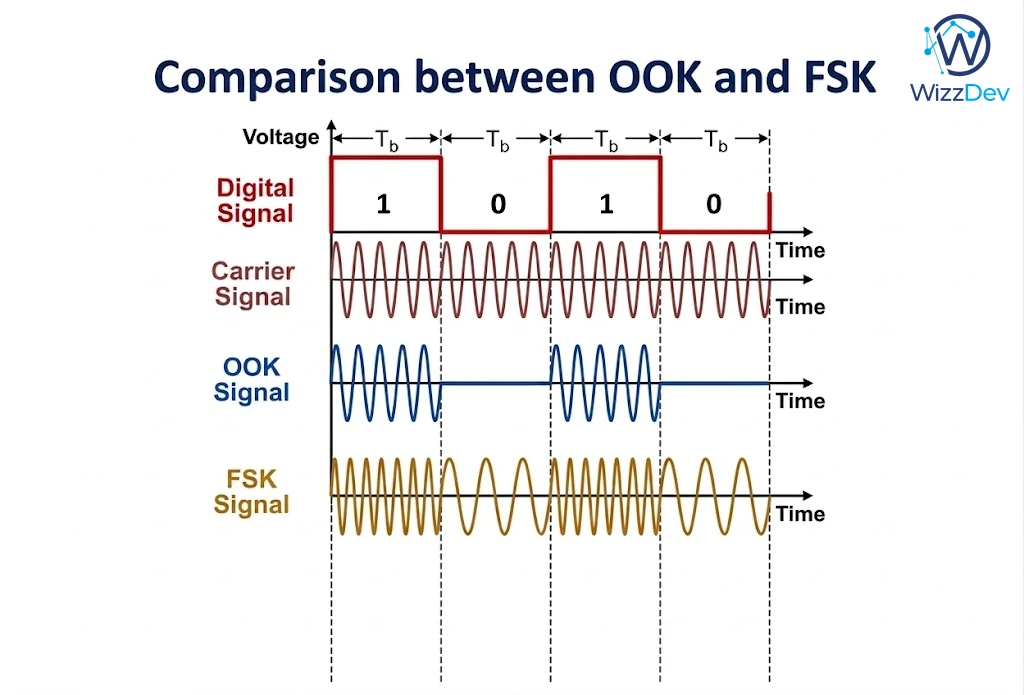
The simplest form of digital modulation is On-Off Keying (OOK), which is the same method the engineers used for Morse code transmission and is exactly what it sounds like:
to send a 1, you turn on the transmitter and broadcast the carrier wave;
to send a 0, you turn it off.
OOK is incredibly easy to implement and uses little power since the transmitter is off half the time. It is still used today, for example, in garage door openers and basic 433 MHz weather stations. However, it has a big flaw: it is very sensitive to noise. Because a 0 is literally “nothing,” a sudden spike in background RF noise can easily trick the receiver into thinking it just heard a 1.
OOK is an extreme version of ASK, where you modify the amplitude of the carrier wave to represent data, rather than just turning it completely on or off.
Frequency-Shift Keying
To solve the noise problem, protocols like POCSAG use Frequency-Shift Keying (FSK). Instead of turning the carrier wave on and off, the transmitter stays on the entire time. To send data, it slightly shifts the carrier frequency.
The frequency is shifted slightly lower than the center carrier frequency to send 1s, and slightly higher to send 0s. Because the receiver looks for specific frequency changes rather than raw signal strength, FSK is much more robust against background noise and interference than OOK. That is the core of the OOK vs FSK trade-off: OOK is simpler and saves power by switching the transmitter off, while FSK keeps the carrier on and gets much better noise immunity in return.
If you look at modern IoT protocols like Bluetooth Low Energy (BLE) or Z-Wave, you won’t see raw FSK; you’ll see GFSK (Gaussian Frequency-Shift Keying), DSSS (Direct Sequence Spread Spectrum), OFDM (Orthogonal Frequency-Division Multiplexing), CSS (Chirp Spread Spectrum), or others. Those have additional features implemented that allow them to be more robust, faster, two-directional, and more.
Once the physical way to send 1s and 0s is known, a set of rules has to be established so that the receiver can make sense of the incoming stream of bits. Most radios follow the same basic RF packet structure: a preamble and sync word first, and only then the actual data. Let’s show this on the POCSAG protocol as an example.
How the preamble and sync word work in POCSAG
A radio receiver doesn’t sit at full power all the time because it drains the battery.
On a modern sub-GHz transceiver like the Silicon Labs SI4463, active receive (RX) mode draws 10-14mA. Instead, the radio duty-cycles, waking up periodically to sniff the air. In sleep, it draws < 1 µA. To ensure the receiver catches the start of the message, it uses a preamble.
So what is a preamble in wireless communication? It is a specific, repetitive sequence of bits designed to wake up the receiving hardware. In POCSAG, the preamble consists of a repetitive 10101010 pattern of 576 bits. The pattern is similar in many other protocols, but in most cases it is not that long. This gives the receiver time to fully wake up, adjust its amplifiers to the strength of the incoming signal, and adjust its internal clock to the clock of the transmitter.
The long preamble also means the receiver doesn’t have to listen all the time. For example, if the preamble takes 1 second to transmit, the receiver can listen for only a short moment each second to check if a preamble is in the air. This approach is known as wake-on-radio, and many low-power radios still rely on it today.
Aligning the receiver
So the preamble is there to catch the receiver’s attention. Once the receiver is awake and ready, it waits for the Sync Word, which is a unique, chosen sequence of bits that acts as a definitive start line. In POCSAG, it’s the exact hexadecimal sequence 0x7CD215D8. Now the two devices are perfectly aligned, and the receiver knows that the very next bit is the start of the data payload.
In the actual C code, we don’t need to poll the radio module over the SPI bus all the time and search for the sync word bits. In the mentioned SI4463, we can configure the SYNC_BITS properties with our sync word value, set the allowed number of errors in bits, and the chip will inform us over an interrupt GPIO that it found a message for us.
In the real world, not every character string can act as a good syncword. If it has too many alternating 1s and 0s (like 0xAAAA), it can be mixed with the preamble, or it could generate false sync word detection events. This can cause the device to miss some messages, or the power-hungry MCU will be woken many times for no reason.
Batches
POCSAG organizes its data into Batches. Each batch starts with the same start sequence, followed by 8 “frames” of data, where each frame contains two 32-bit codewords. An address codeword tells the pager if this message is meant for its specific ID, and a message codeword contains the actual text (encoded in 7-bit ASCII) or numeric characters to display on the screen. To fill the unused space in the last batch: idle words are used, which also tell the receiver that the message has finished.
The SI4463 also has a buffer and can deliver whole batches to our MCU, and we only have to decode it. Older receivers often provided only a bitstream of data, and the MCU had to handle first the bit synchronization and batch preparation, which was not easy because of the different clock the MCU was based on.
How modern IoT protocols catch a receiver's attention
POCSAG is a very simple and robust way to send messages, used for many years in pagers, but it’s one-way-only communication; the transmitters consume a lot of power, and the receiver’s radio must stay on for a long time because of the long preamble and slow communication.
Modern protocols are more efficient, and they either have a long preamble, which is easy to catch for the receiver but wastes a lot of energy by the transmitter, or they have a short preamble, which is great for the transmitter, but the receiver must wake up with very high precision. For a wider comparison of the options, see our overview of IoT communication protocols.
Bluetooth communication
Bluetooth took the short preamble path and designated three specific channels just for advertising. With these BLE advertising channels, the receiver knows exactly where to listen, and the preamble can be only 8 or 16 bits long. Once the devices synchronize, they agree on a hopping method and talk to each other on a different channel.
LoRa communication
LoRa does not use FSK; it uses CSS. It sweeps across frequencies, which is called chirping. To reduce battery consumption, it also uses a feature called LoRa channel activity detection (CAD). The radio wakes up for a very short time, less than one millisecond, and checks for the distinct shape of a chirp. Only once it sees it, it stays on and wakes the microcontroller.
LoRa packets also carry a short start marker after the preamble. The LoRa sync word is a single byte, typically 0x12 for private networks and 0x34 for public LoRaWAN networks, which lets a receiver ignore packets from networks it doesn’t belong to.
WiFi communication
Wi-Fi, on the other hand, first checks the energy level of a channel; if someone is talking, it looks for a different one. To keep the network synchronized, the routers constantly send Beacon frames, which act as a network-wide sync signal.
Conclusions
Every RF link, from an old pager to a modern IoT sensor, solves the same problem: getting a receiver’s attention in a noisy band. Digital modulation decides how ones and zeros look on the air, and the choice between OOK and FSK is a trade-off between simplicity, power use, and resistance to noise.
The preamble and sync word do the rest. The first wakes the receiver and lets it adjust to the signal, and the second marks the exact point where the data begins. Modern protocols such as BLE, LoRa, and Wi-Fi refine the same idea with dedicated advertising channels, channel activity detection, and beacon frames, which makes wireless communication faster, more reliable, and more energy-efficient.
But whether it is Pager communication or modern BLE or Wifi devices, the physics haven’t changed; the transmissions are just becoming faster and less power-hungry.
Key takeaways
A preamble is a repetitive bit pattern that wakes the receiver and gives it time to adjust its amplifiers and clock to the incoming signal.
The sync word tells the receiver exactly where the data payload starts.
OOK is simple and saves power, but FSK copes much better with background noise because the carrier never switches off.
A long preamble enables wake-on-radio, so the receiver only needs to check the air briefly instead of listening all the time.
BLE, LoRa, and Wi-Fi apply the same idea through advertising channels, channel activity detection, and beacon frames.