
This case study details the embedded software architecture and high-throughput data pipeline engineered by WizzDev for a Client’s automated edge analytical platform. While the Client developed the physical execution hardware and proprietary sensor technology, WizzDev was brought in to resolve critical software throughput and reliability bottlenecks.
Peak raw sensor output reached ~500 MB/s (uncompressed) during high-activity phases within a 20-minute acquisition window, exceeding the physical ~300 MB/s write limit of the target storage device (although faster storage drives are easily available, it was a strict business requirement due to existing infrastructure). By applying real-time in-flight compression, the host software reduces the payload down to a compressed total of ~50 GB per 20-minute run (an effective write rate of ~42 MB/s), allowing to easily meet the allowed data throughput and saving the storage space at the same time.
This I/O bottleneck affected the entire design of the data pipeline – from capturing and decoding packets from the USB, through saving them on disk to the processing pipeline. It is crucial to note the experiment data are 3D multidimensional data slabs, which also affected the storage requirements, to later facilitate their processing.
HDF5 perfectly matched our requirements, with multidimensional data slabs, real-time compression filters and multiple parallel readers while simultaneously writing the data.
Due to the hardware performance, both RAM and CPU/GPU, the processing was also optimised, including minimising data copying between buffers in RAM and memory access patterns by the data processing algorithms.
Isolating microsecond-sensitive hardware safety loops (heaters, pumps, pressure failsafes) from high-level Python state orchestration and analytics. A failure or mid-run restart in a high-level UI or logging service must never compromise the deterministic execution of the 10-hour physical sequence or corrupt active file handles.
The Client’s primary product objective was to condense a traditional laboratory footprint into a localized, desktop-sized edge unit. To realize this hardware vision, WizzDev was tasked with engineering the resilient software architecture and data pipeline required to govern the unit’s complex 10-hour execution sequence and manage its massive telemetry stream.
Inspecting accumulated multi-run experiment files (~150 GB compressed HDF5 archives) directly on memory-constrained edge hardware without exceeding system RAM limits. To resolve this, WizzDev implemented HDF5 memory-mapped slice indexing (lazy loading) within the Python desktop dashboard, enabling sub-second time-series navigation with a RAM footprint strictly under 500 MB.
The Client’s primary product objective was to condense a traditional laboratory footprint into a localized, desktop-sized edge unit. To realize this hardware vision, WizzDev was tasked with engineering the resilient software architecture and data pipeline required to govern the unit’s complex 10-hour execution sequence and manage its massive telemetry stream.
WizzDev’s primary engineering challenge was a fundamental I/O mismatch: the gap between high-velocity signal generation and the physical limitations of data persistence. In this environment, failing to process and store data in real-time results in “dropped samples,” which compromises the integrity of the entire 10-hour experiment.
The system’s high-fidelity sensor array generates a peak uncompressed raw data stream of up to 500 MB/s (which would equal ~600 GB of raw telemetry over a full 20-minute acquisition window). However, the physical write limit of the targeted storage media was constrained to 300 MB/s. By executing real-time in-flight compression (~12:1 compression ratio), the pipeline reduces the dataset to ~50 GB of compressed binary data per 20-minute run (averaging ~42 MB/s write speed), comfortably bypassing the storage write limit without frame loss.
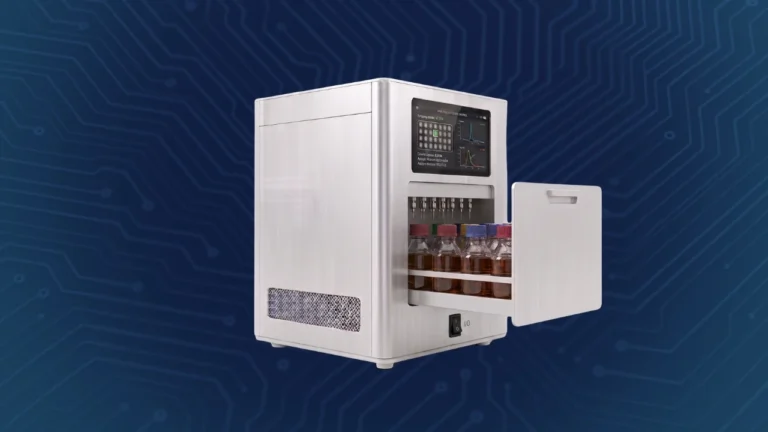
WizzDev’s primary engineering challenge was a fundamental I/O mismatch: the gap between high-velocity signal generation and the physical limitations of data persistence. In this environment, failing to process and store data in real-time results in “dropped samples,” which compromises the integrity of the entire 10-hour experiment.
To safely actuate the high-current heating elements, the hardware incorporates a transistor-driven 10A relay supporting both standard and bistable NC/NO configurations. Accurate, real-time thermal feedback is continuously captured via an external, cable-mounted sensor (such as the ENS210 or AHT20) communicating over an isolated I2C bus, allowing the electronics to remain protected while the probe undergoes direct thermal coupling with the water supply.
From a software perspective, the architecture was designed to prioritize autonomous reliability. The device utilizes the native ESP32 Wi-Fi Mesh protocol to act as a resilient communication node within the wider appliance network. Concurrently, it runs a localized 24-hour scheduling engine directly at the edge, ensuring that precise temperature thresholds and user routines are strictly maintained even during complete network or cloud outages.
To resolve the throughput bottleneck, the system interfaces with an external FPGA board dedicated to high-frequency raw sensor data acquisition. The C++ host software layer ingests the incoming stream directly from the FPGA, decodes the proprietary frame format, and executes real-time in-flight compression before serializing the dataset via the HDF5 library.
By managing stream buffering and compression at the host software level, the pipeline successfully bypasses the 300 MB/s disk write cap without data loss.
For long-term management of these massive datasets, which aggregate to ~150 GB of compressed HDF5 telemetry per full operational cycle, we adopted the HDF5 (Hierarchical Data Format version 5) open binary format. This choice was strategic, supporting “lazy loading” capabilities. It allows the system to handle multi-gigabyte files by only accessing specific data subsets as needed, which is essential for stable post-processing on edge hardware with limited RAM.
The system governs a complex, 10-hour automated control loop using a decoupled microservices architecture. Rather than relying on a monolithic controller, discrete services independently manage hardware domains while continuously streaming operational telemetry to a centralized storage engine.
Acts as the single coordinator for file access, managing concurrent write streams from all sub-systems into the HDF5 archive without race conditions or I/O locks.
A dedicated ingestion service focused exclusively on reading and buffering high-speed binary frames from the FPGA interface.
Isolated services that execute physical control loops while capturing real-time sensor metrics:
Executes deterministic heating profiles (e.g., 2°C/min ramp) and streams temperature curves.
Coordinates multi-pump reagent mixing, dosing sequences, and flow rate telemetry.
Continuously polls pressure/temperature sensors with hard-coded failsafes (e.g., automated shutoff on pressure spikes)
Dedicated hardware board responsible for capturing raw high-frequency signals from the sensor chip and streaming raw binary frames over USB to the host computer (offloading data decoding and compression completely to the host C++ software stack).
A specialized, low-noise bridge designed to capture high-velocity physical and sensor signal variations with extreme fidelity prior to digital conversion.
The hardware layer manages pumps, mixers, and heaters through precise feedback loops to maintain specific chemical-thermal environments.
A high-speed interface optimized to ingest peak uncompressed telemetry bursts of up to 500 MB/s from the FPGA over standard COTS hardware connections (USB-to-Host), buffering and compressing the stream in software before committing to storage.
Implemented in C/C++, this layer provides Deterministic Control over hardware components. It ensures timing-critical tasks, such as actuator positioning and sensor polling, are executed with microsecond-level precision.
A Python-based engine providing service-level isolation. By modularizing functional domains (thermal control, fluidic management, logging), we ensure that a failure in a high-level service cannot compromise the underlying hardware state or the 10-hour process.
Implemented in C++, this host-side engine bridges the FPGA hardware interface and the file system. It ingests raw binary telemetry packets directly from the FPGA, decodes the frame structure, and executes software-level in-flight compression before streaming datasets into structured HDF5 binary archives.
An intermediate interface that enables operators to define complex sequences (e.g., specific thermal ramps) through high-level commands, abstracting the underlying low-level code.
Beyond performance, the hardware is the final line of defense for system integrity. Integrated safety loops are hard-coded to detect anomalies in fluidic pressure or thermal runaway. These loops trigger immediate, autonomous shutdowns to prevent high-pressure fluidic breaches or the compromise of the internal electronic assembly.
The solution provides an adaptable engineering blueprint for industries operating at the intersection of high-velocity sensor data and storage I/O constraints. Below are the primary commercial sectors and application areas where this architecture delivers immediate technical and business value.
Pilot-plant chemical reactors, automated fluidic dosing systems, and environmental test chambers.
Remote climate control, off-grid water heating systems, industrial pump stations, energy-management edge nodes
Ultrasonic flaw detection, high-rate vibration analysis, optical quality inspection, and semiconductor chip testing.
| Stage | Min h | Max h | |
|---|---|---|---|
|
Architecture design, storage and APIs specification |
60 |
80 |
|
|
USB driver for high-throughput data reception from FPGA
|
78 |
94 |
|
|
FPGA Frames handling, decoding and dispatching
|
84 |
96 |
|
|
HDF5 data storage module
|
122 |
136 |
|
|
HDF5 data read module (C++ core and Python wrapper library)
|
86 |
94 |
|
|
HDF5 compressed storage, performance benchmarking and stress testing
|
108 |
124 |
|
|
Low-level hardware control (pumps, heaters)
|
84 |
92 |
|
|
Engine for high level control scripts (in Python)
|
72 |
86 |
|
|
High level control logic in Python script
|
122 |
142 |
|
|
High level data processing pipeline (data processing algorithms – both CPU and GPU optimised)
|
144 |
162 |
|
|
Visualization GUI & analytics dashboard
|
132 |
146 |
|
|
CI/CD, deployment, configurations and telemetry |
96 |
104 |
|
|
Integration and system testing with real hardware |
140 |
160 |
|
|
Documentation, handover and support
|
54 |
68 |
|
|
Total project time |
1408 |
1616 |
Note: To the final total project estimated time might be added up to 15% of time for risk assessment.