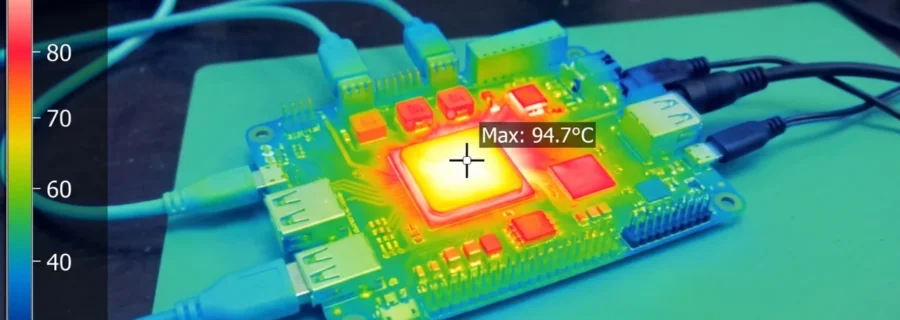
In embedded and IoT development, the most expensive bugs never show up in your local compiler or staging environments. Instead, they manifest at the intersection of three conflicting realities: physical thermal dynamics, asynchronous low-level firmware loops, and the elastic billing models of cloud infrastructure.
At WizzDev, we have spent years engineering, auditing, and scaling connected systems. We have seen firsthand how designing these layers in silos leads to far more than a simple software crash. It could have resulted in – depending on the culprit – deformed enclosures, bricked device fleets, or runaway cloud bills that scale faster than your user base.
Moving from a lab prototype to a high-volume production fleet is where generic engineering practices fail. Drawing on our deep experience in hardware-software co-design, we have compiled 6 systemic architectural risks that CTOs and engineering leaders must navigate to build truly production-ready IoT products.
1. The bricking risk. Certificate rotation and the danger of fleets going offline
Secure communication between an edge device and a cloud broker (such as AWS IoT Core) relies on the TLS protocol and cryptographic validation of the chain of trust. A standard chain consists of a Root Certificate Authority (Root CA), intermediate certificates, and the device’s unique leaf certificate.
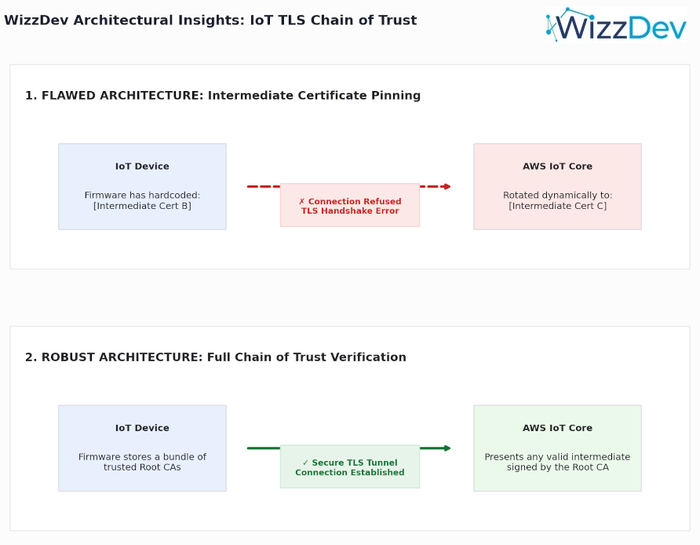
A severe and surprisingly common engineering error is hardcoding (pinning) a specific intermediate certificate directly into the microcontroller’s non-volatile memory. Cloud providers, adhering to industry security standards, regularly and autonomously rotate their intermediate certificates (for example, AWS maintains a pool of several intermediate certificates and dynamically shifts traffic between them).
If the edge firmware validates the server connection using only a single, hardcoded intermediate certificate, the moment the cloud provider switches to an alternate certificate in the pool, the device will reject the TLS handshake as untrusted. The device instantly loses connection at the transport layer.
This means your primary Over-the-Air (OTA) update channel, whether Wi-Fi or cellular, is blocked. Your active fleet of thousands of devices becomes a collection of bricked units, requiring manual, physical recovery.
Architectural Recommendations
Validate up to the Root CA. Firmware must be engineered to validate the full cryptographic chain of trust back to the trusted Root CA, rather than pinning temporary intermediate certificates. The microcontroller should store a complete, updatable bundle of trusted Root CA certificates.
Implement a Local Recovery Interface (BLE Backdoor). When we architect connected devices at WizzDev, we enforce the implementation of a secondary, local firmware update interface. Even if product requirements do not explicitly mandate Bluetooth Low Energy (BLE) functionality, leaving a secure, lightweight BLE OTA update routine in your production code acts as a vital backdoor. In the event of a TLS lockout, end-users can trigger a local Bluetooth connection via a companion mobile app to push a recovery firmware patch, preventing a catastrophic recall.
2. The traffic takeover hazard. How hardcoded IP addresses bypass DNS security
During prototyping, embedded engineers often attempt to simplify the network stack by bypassing domain name resolution and hardcoding raw IPv4 addresses directly into firmware. It is a common shortcut seen in custom MQTT broker deployments.
In dynamic cloud environments, public IPv4 addresses are volatile resources. During cloud migrations, server re-allocations, or routine infrastructure shifts, old IP addresses are continuously released back into the provider’s public pool.
If deployed devices hardcode an IP address instead of using DNS, they will blindly continue transmitting MQTT telemetry payloads and configuration requests to that numerical address after it has been released. If the cloud provider reassigns that IP to an unrelated third party, your fleet will stream telemetry directly to an alien server. Because the firmware lacks DNS resolution to redirect traffic to your legitimate broker, you lose all ability to reach, control, or patch the fleet remotely.
Architectural Recommendations
Every MQTT connection initiated by the microcontroller must resolve server endpoints dynamically using domain names rather than static IP addresses.
Honor DNS TTL. The device’s TCP/IP stack must strictly respect Time-To-Live (TTL) parameters in DNS records to react promptly to cloud-side infrastructure changes.
3. Hardware-software silos. When "firmware bugs" are actually thermoplastic deformations
A lack of tight integration between electronics designers (hardware) and embedded developers (software) creates severe technical debt that delays product rollouts. Frequently, system instability under load is classified as a firmware bug when the root cause lies in physical material behavior and mechanical stress.
Consider a compact smart home relay designed for an in-wall electrical junction box, rated for a continuous 10A load. Under test conditions with a resistive load drawing 9.5A, the device begins dropping off the Wi-Fi network, freezing, and resetting. Embedded developers can spend weeks debugging RTOS tasks and optimizing network drivers, suspecting memory leaks or electromagnetic interference (EMI).
The actual root cause is electro-mechanical. High current flowing through thin PCB traces and relay contacts generates significant thermal dissipation. As internal temperatures rise, the thermoplastic enclosure deforms under heat. While plastic itself is an electrical insulator and cannot directly short component pins, the warping housing exerts physical pressure on the PCB, forcing the board to flex. This mechanical stress causes micro-cracks in solder joints (creating intermittent open circuits) or flexes adjacent conductive component pins into direct contact with each other, triggering immediate power drops and hardware resets.
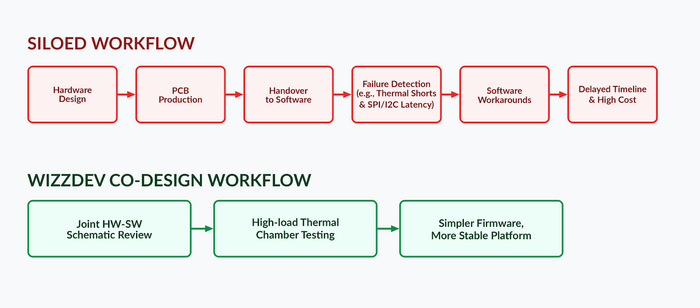
Similar silo-driven issues occur when hardware teams configure SPI or I2C bus routings with excessive parasitic capacitance, preventing stable high-speed data transmission without complex software workarounds.
Architectural Recommendations
Cross-Disciplinary schematic reviews. In our engineering workflow at WizzDev, firmware developers participate in early hardware schematic and layout reviews to identify bus conflicts and resource constraints before tape-out.
Thermal and load stress testing: High-power devices must undergo continuous load testing (100% duty cycle at maximum rated amperage) inside sealed production enclosures, while monitoring internal temperatures and voltage rail stability.
Prioritize Hardware Revisions: Masking physical hardware flaws with complex software loops drastically degrades long-term stability. Pushing back on hardware layout design to fix routing or physical tolerances can make your codebase 5x simpler and 10x more stable.
4. The sealed battery trap. Managing requirement drift before high-volume tooling
Designing low-power, battery-operated IoT devices (such as industrial telemetry nodes or leak detectors designed to run for a decade on a single cell) requires extreme energy management. The primary risk in these projects is uncontrolled requirement drift after physical parameters have been frozen.
If expensive injection molds for a sealed enclosure (such as an IP67/IP68 rated housing) are manufactured early in the design cycle, the PCB geometry and battery specifications are locked in. If the product owners subsequently decide to change the wireless transceiver (e.g., swapping a standard module for a longer-range radio with a different current profile), the engineering team faces a structural mismatch. They must integrate a more power-hungry radio into a fixed physical footprint and battery budget.
If a microscopic firmware bug goes undetected, such as an uncleared interrupt flag that prevents the microcontroller from entering its ultra-low Deep Sleep state (measured in microamps), the device will continuously draw current in the milliamp range. Consequently, 15% of the manufactured inventory will completely drain and die while sitting in the warehouse. Because the enclosure is ultrasonically welded shut and lacks external test points, diagnosing the quiescent current draw or updating the firmware is impossible without destroying the enclosure with a saw.
Architectural Recommendations
Freeze hardware specifications before tooling. Our design guidelines at WizzDev dictate that high-volume plastic injection mold tooling (representing a major capital expenditure) must not be approved until the microcontrollers, transceivers, and batteries are fully locked and validated.
Expose external test interfaces on pilot batches. Ensure that early-stage production runs include accessible PCB test pads or external debug ports to measure quiescent current draw and reflash firmware without destructive physical access.
5. The serverless billing trap. How micro-bugs in firmware explode AWS infrastructure expenses
The infinite scalability of serverless architecture is a double-edged sword. From an operational expense (OpEx) perspective, serverless backends will endlessly scale up to accommodate your worst firmware design errors, billing you for every redundant operation.
When scaling an IoT fleet to tens of thousands of devices, minor mismatches in embedded firmware can cause exponential cloud cost inflation. Common culprits include:
Telemetry float inconsistencies
Some devices format floating-point values to 4 decimal places, while others format them to 5 decimal places. The cloud ingestion layer flags this tiny difference as a state change, triggering an immediate write operation.
Unbuffered data transmission
The firmware is programmed to transmit an unbuffered MQTT message the instant any sensor value or user interaction occurs, instead of buffering parameters locally and sending a single, consolidated payload at scheduled intervals.
At scale, sending thousands of redundant messages per hour drives up operational billing. Each message forces database writes, triggers rules engines, and generates costly read/write API calls to the AWS Device Shadow. Furthermore, repetitive, uncached queries to AWS Secrets Manager and verbose Lambda debug logs saved to CloudWatch can quickly cost more than the actual compute power of the entire backend.
Architectural Recommendations
Based on cloud audits and optimizations we have executed at WizzDev, we recommend the following cost-containment strategies:
Firmware-side aggregation and rate limiting. Implement local message queuing in the firmware to aggregate telemetry and throttle Device Shadow state updates to a strictly defined interval.
Utilize AWS basic ingest. Leverage features like Basic Ingest to bypass message broker transaction costs for high-frequency, non-publish/subscribe telemetry streams.
Active device shadow caching. Implement a caching layer on the backend to minimize direct, costly API read/write operations on virtual device registries.
Implement sampled logging. Limit detailed debug logging in the cloud. We restrict detailed logging to a small, sampled percentage of cloud invocations (e.g., 1% of Lambda executions) while logging only critical failures for the rest.
6. Scale-up latency. Database optimization and time-series bottlenecks in production deployments
Deploying an enterprise IoT system onto an active industrial facility (such as an automated logistics yard using RFID and heavy vehicle scales) or running a major cloud database migration are high-risk operations. Bypassing load testing and deploying without a step-by-step migration plan is a direct path to operational paralysis.
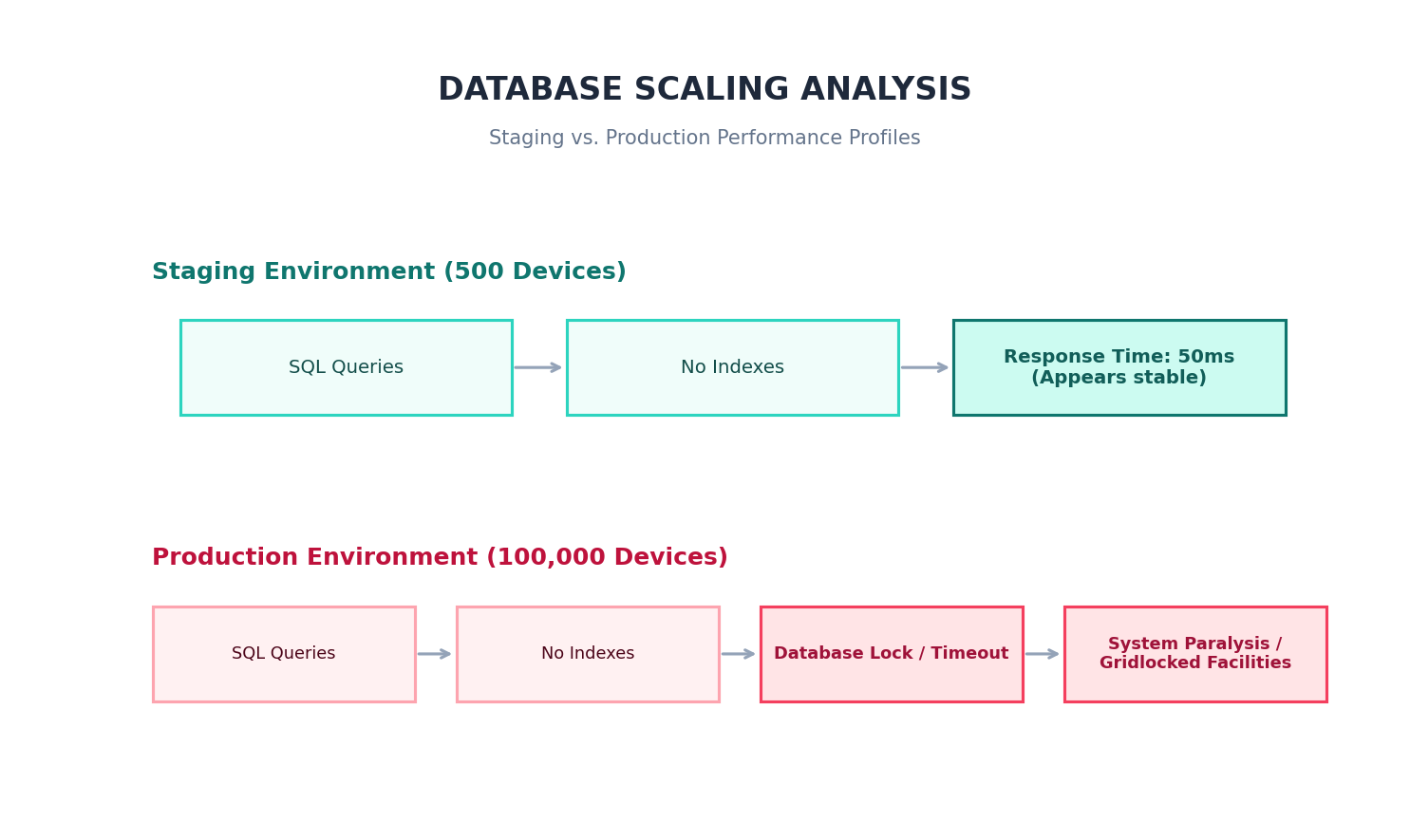
IoT architectures generate vast volumes of time-series data. Standard relational databases or poorly structured tables within specialized time-series databases may perform flawlessly in a staging environment under a simulated load of 500 to 1,000 devices.
However, once deployed at scale (e.g., 100,000 active devices reporting status changes), the lack of database indexing or improper partitioning will cause the database queries to lock up under production volume. Query response times scale from milliseconds to seconds, central services experience major lag, users cannot log into companion mobile apps, and edge devices fail to establish stable sessions.
For physical deployments in industrial logistics, database latency paralyzes real-world operations. A slow system gate response time from 15 seconds to several minutes can quickly back up industrial vehicles, causing a 10-kilometer-long traffic gridlock on surrounding public roads and requiring police intervention to resolve.
Architectural Recommendations
Develop a detailed rollback plan. Every production migration or industrial deployment must follow a strict, minute-by-minute deployment plan scheduled during low-traffic windows. A verified rollback protocol must be ready to restore the legacy system within minutes if latency thresholds are exceeded.
Enforce stress testing on inherited legacy code. Our technical approach when taking over legacy cloud systems is to immediately execute a complete database performance audit accompanied by load simulations that replicate the maximum expected fleet volume.
Optimize time-series schema design. Telemetry data must be routed to databases optimized specifically for time-series structures (e.g., TimescaleDB, InfluxDB) with automated aggregation policies, data retention schedules, and carefully designed primary/secondary index layouts.
No one said that engineering resilient IoT architectures would be easy
Designing dependable IoT products requires engineers to think beyond their narrow disciplines. As we said in the beginning of this article, systemic reliability is forged at the interfaces of physical enclosures, embedded code, and cloud architectures.
Understanding how a physical enclosure’s thermal behavior impacts PCB traces, how firmware logic affects serverless bills, and how database configurations behave under peak loads is critical to delivering a cost-effective IoT product.
At WizzDev, we help engineering teams and product owners bridge these technical divides. By uniting hardware, embedded, and cloud engineering under a single, highly aligned methodology, we ensure that your product scales securely, stably, and cost-effectively from day one.
Before transitioning your next product revision to mass production, challenge your engineering team with these three questions:
Do we have a secure, secondary local channel (such as BLE) to recover devices if our primary TLS cloud connection fails?
Do our firmware payload formats and AWS configurations prevent runaway billing if our fleet scales to 100,000 devices?
Have we stress-tested our database schemas to their absolute limit, and do we have a verified rollback plan for our next deployment?
Key Takeaways
Eliminate the “bricking” hazard by validating cryptographic chains back to the Root CA and maintaining a secondary local recovery interface like BLE for emergency OTA updates.
Protect network integrity by strictly enforcing DNS resolution and TTL parameters instead of hardcoding volatile public IP addresses in firmware.
Bridge the hardware-software silo through integrated schematic reviews and thermal stress testing to prevent physical deformations from masquerading as firmware bugs.
Avoid the “sealed battery trap” by locking hardware specifications before committing to expensive injection mold tooling and exposing debug interfaces on pilot batches.
Control cloud OpEx by aggregating data on the firmware side and sampling logs to prevent minor firmware inconsistencies from triggering massive serverless billing.
Ensure production stability by stress-testing time-series database schemas and establishing a verified rollback protocol before every fleet-wide deployment.