IoT product validation through pretotyping lets you check whether customers will pay for your device before you spend your budget on engineering. We at WizzDev see the same pattern with many of our clients. They come to us with a hardware idea and want to race straight to a prototype and an MVP, asking what development will cost and which features we can add.
However, before we design a single PCB, we like to ask one question: is there a market for this product? In this article, we explain what a pretotype is and why it matters even more for hardware than for software. We also share how two of our clients used crowdfunding to raise hundreds of thousands of dollars before their products existed.
Why IoT product validation should come before the prototype
Most hardware founders treat development as the first milestone. They check whether the device is technically possible and start building as soon as the answer is yes. The question that decides the fate of the product comes much later: will anybody buy it?
We have seen teams spend their entire runway on a prototype and an MVP, then reach launch day with no money left for marketing and sales. At a company with over 8 years’ experience, we value long-term partnerships, and those only last when our clients’ products succeed. This is why we strongly advise looking at the step before the prototype — a pretotype.
What is a pretotype?
A pretotype is a fake product. It shows your market what the device will do and which problem it solves, but nothing inside it works, or almost nothing. Many of our clients skip this stage, and we often encourage them to go back and consider it.
Alberto Savoia, Google’s first engineering director and an innovation lecturer at Stanford, coined the term. Instead of asking engineers to build the idea, you ask the market to prove that it wants the idea first.
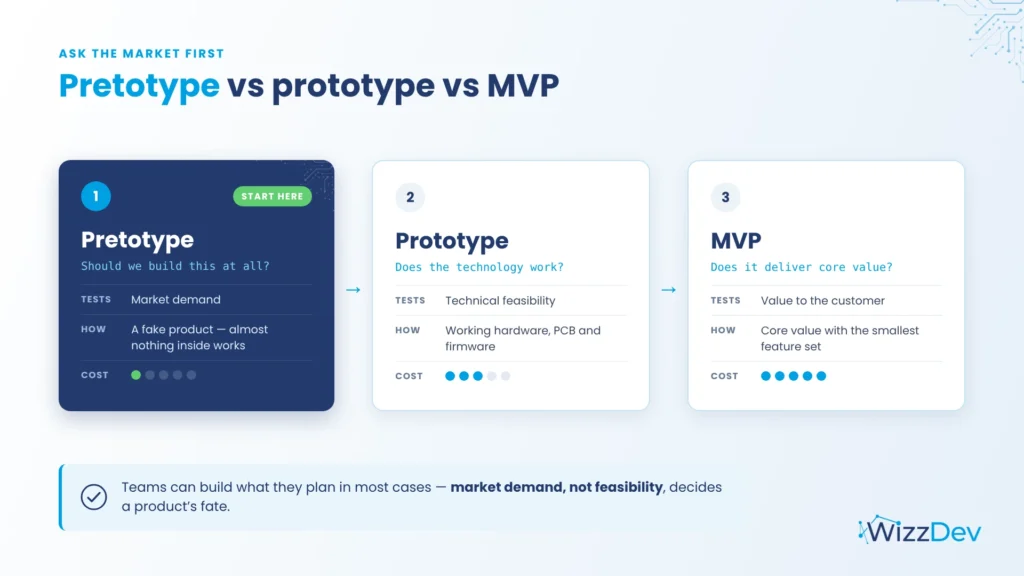
Pretotype vs prototype vs MVP
A prototype checks whether the technology behaves as planned, and an MVP (minimum viable product) delivers the core value with the smallest possible feature set. Both prove that something works. A pretotype asks an earlier and much cheaper question: should we build this at all? Savoia notes that teams can build what they plan in the vast majority of cases, so market demand, not feasibility, usually decides a product’s fate.
Why opinions mislead and cash doesn't
For many founders, market research means showing renders of the enclosure to potential customers and investors. Their nods and objections tell you surprisingly little.
Opinions do not predict behaviour. In his Stanford lectures, Savoia describes how people praised his ideas and urged him to build them, then declined to buy the finished product. He tells entrepreneurs to forget surveys and collect their own data with real skin in the game.
Our experience points the same way. One data point correlates very strongly with market traction, and it is cash. If somebody pays for your device, you know they will buy it, because they just did. A pretotype lets you collect that KPI without leaving the customer cheated or offended.
Why pivoting a hardware product costs so much more
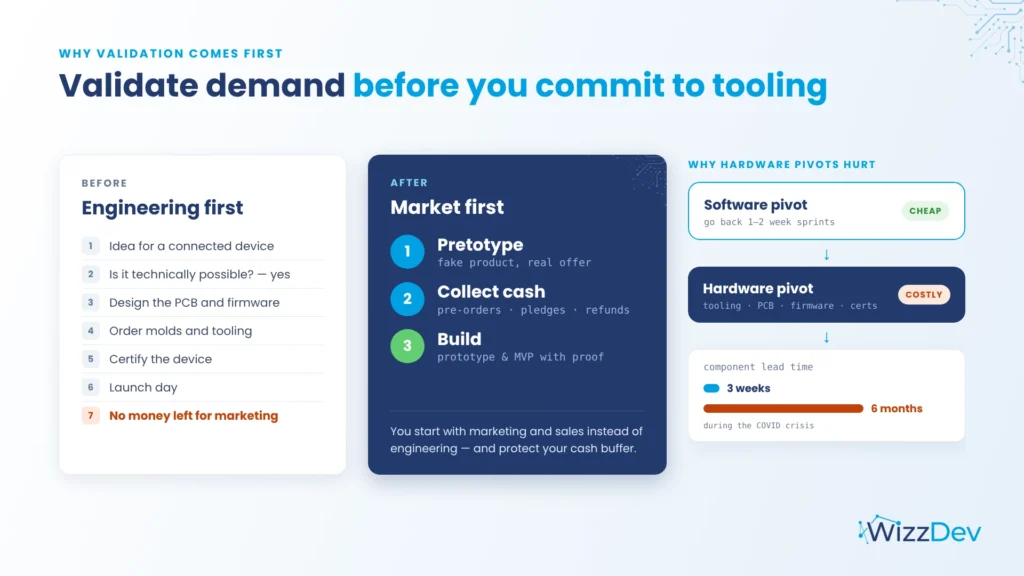
Software teams can afford to jump straight into development. They work in one- or two-week Scrum iterations, so a pivot usually means going back a few sprints and reusing familiar modules such as authentication.
Hardware is a different story. The enclosure needs molds or 3D prints, and the PCB takes weeks to design and manufacture. Low-level firmware is also slower to change than application code. Certification brings extra costs as well, as our breakdown of Matter device launch costs shows.
If the plastic you chose causes problems after launch, the alternative may be unavailable or too expensive. During the COVID crisis, components with a three-week lead time suddenly needed six months, and many teams couldn’t relaunch a redesigned product.
A pretotype lets you validate your IoT device and de-risk all of this before you commit to tooling. You start with marketing and sales instead of engineering, which protects your cash buffer. The focus moves from whether the product is possible to whether anyone will buy it. In our view, this shift also helps founders concentrate on the real problem their customer has.
Practical ways to pretotype a smart device
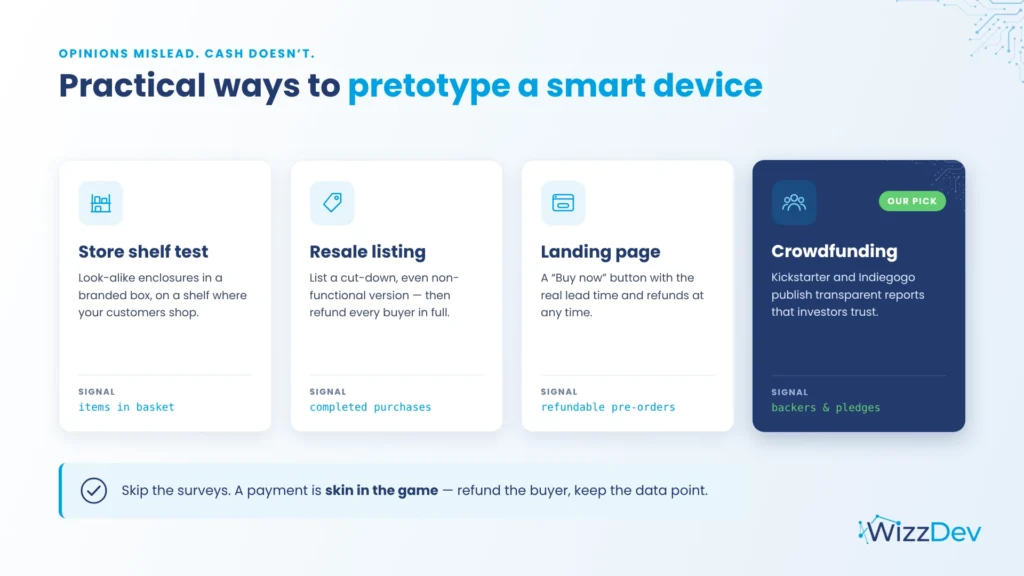
These are the methods we recommend most often to our clients.
Putting a fake product on a store shelf
Savoia shares the example of a San Francisco team that designed the Wall Hub, a plastic organiser for keys and mail. Before ordering 10,000 units, they tested the idea in an IKEA store and watched whether shoppers would pick it up.
The same logic works for a connected device such as a smart plug. Build a few enclosures that look almost identical to the planned product and put them in a branded box on a shelf where your customers shop. Even six or seven people putting one in their basket give you real data points, and nobody loses money.
Listing a cut-down version on resale platforms
You can list a cut-down, even non-functional version of your product on a second-hand marketplace. When someone buys it, you refund them in full and explain the test. You keep the data point, and the customer keeps their money.
Landing pages with refundable pre-orders
A landing page with a “Buy now” button works similarly. Buyers see the expected lead time for the real product and can request a refund at any time. A handful of orders may not settle the decision, but it tells you far more than a survey.
Crowdfunding as our preferred pretotyping method
The approach we advocate most often is crowdfunding on Kickstarter and Indiegogo, and at least two of our clients have run successful pretotypes there. These platforms publish transparent reports that investors trust. When an investor sees that 2,000 people paid for a product before it existed, the startup looks far more attractive.
A study of technology projects on Kickstarter backs this up: higher campaign pledges increase a venture’s chances of securing funding from professional investors. A successful campaign saves money in the long run and gives founders a fast track to venture capital.
How our client Modue raised over $500,000 on Kickstarter
Modue built an IoT controller with uses ranging from home control to DJ sets. It was their first crowdfunding campaign, and they had no finished product at the time, only a prototype and compelling videos. The campaign raised over $500,000 on Kickstarter, and all of that money went into building the actual product. More importantly, the large number of backers gave Modue the data points they needed to secure investors.
How our client Pocketethernet funded its entire product
Builders who install Ethernet cabling used to test each cable by carrying a laptop around the site and plugging it into diagnostic software. The Pocketethernet team replaced that setup with a tiny microcontroller-based device and a mobile app. It offers better diagnostics at a much lower cost and fits in a pocket. Their Kickstarter campaign raised over $200,000, enough to fund the whole product, which is now on the market and generating revenue.
Pretotyping works for established brands too
Crowdfunding is not only for startups. Large brands launch on Kickstarter and Indiegogo too, but they look for data rather than investors. For a big company, $1 million may not even cover R&D and high-throughput production. Still, campaign data gives internal stakeholders solid evidence for R&D and launch decisions, plus direct customer feedback. Most importantly, it creates early adopters who wait for the product and talk about it before launch.
Conclusion
IoT product validation works best before the first prototype. Hardware pivots cost far more than software ones, and opinions rarely predict what customers will buy. A pretotype gives you the signal that matters: real cash. Whether you test a fake product on a shelf or run a Kickstarter campaign like Modue and Pocketethernet, you protect your runway and collect data that convinces investors. We at WizzDev are happy to help you plan that first test.
Key Takeaways
Pretotyping validates market demand long before you commit to the engineering costs of a prototype or MVP.
IoT product validation requires “skin in the game” because real-world data points involving cash are far more reliable than surveys or opinions.
Physical pivots are prohibitively expensive compared to software iterations due to PCB manufacturing, molds, and component lead times.
Crowdfunding serves as a powerful pretotyping tool to secure transparent market proof that attracts venture capital and investors.
Testing with mockups and landing pages allows founders to protect their cash buffer and focus on solving the right customer problems.